OPEN LETTER
Messrs. François Legault, Prime Minister, and Pierre Fitzgibbon, Minister of the Economy, Innovation and Energy, as leaders of the energy transition file, which you have made a priority for your government for 2023, you seem to want to finally tackle the decarbonization of Quebec's energy system. Well done.
This historic turning point is long overdue: oil, gas and, to a small extent, coal generate 70 % of the territory’s total greenhouse gas (GHG) emissions. To decarbonize Quebec, we must therefore end our dependence on these fossil fuels. However, the fight against global warming cannot be understood in isolation. The solutions proposed must also respond to the constraints posed by other equally existential crises, namely the depletion of resources, the accelerated degradation of natural environments and the collapse of biodiversity.
However, despite your plea for energy sobriety, you seem to take for granted that the continued increase in energy demand is inevitable, that it must mainly be responded to by massively increasing the production of renewable electricity while developing the sector. gases from renewable sources, that the planet can provide the materials necessary for this purpose at realistic costs, that the ecosystems on which the economy depends would withstand this increased pressure and that the population would accept these projects.
In our opinion, nothing is less certain. This is why a real societal debate on Quebec's energy future is necessary, which would include the scientific community, civil society, indigenous peoples and the most vulnerable populations, who risk being penalized by the transition if they are not duly consulted.
Ask the right questions
Do we really need to build “half a Hydro-Québec” or even more, as you postulate, to perpetuate modes of production, consumption, housing and travel that fuel waste and systematically make us break down the wall of planetary boundaries? Among other things, do we really need to harness our last intact rivers to replace seven million gasoline vehicles with seven million electric vehicles? At what ecological, human and economic costs? Are there better options?
Will we really squander public funds for the transition on the large-scale production of so-called “renewable” natural gas which will be fueled by massive removals of forest biomass, the maintenance of industrial farms such as megapig farms and the continuation of food waste?
How many species are we still willing to sacrifice by destroying natural habitats to build new dams, extract the metals needed for electrification or produce so-called “renewable” gas and burn it?
Will the population accept a boom in hydroelectric, wind, mining and other projects? With the threat of oil and gas drilling finally over, do we really want to embark on a new war of attrition between civil society and the government?
If you try to sweep these thorny issues under the rug, your government risks facing a continuing series of outcries that will paralyze climate action rather than spur it.
Target the best choices
As for energy sobriety, you are right to give it priority. However, your recent comments suggest that this responsibility falls primarily on households, who will have to run their dishwasher at midnight and turn down the heating when the house is empty — very logical, but very short, proposals. Indeed, the residential sector is only responsible for 18 % of the energy consumed in Quebec, compared to 28 % for the transport sector and 48 % for industrial, commercial and institutional uses.
Should we understand that, according to you, families will have to increase the number of small energy saving actions at home while your government will continue to inflate the energy excess of the transport sector, by building new highway infrastructures as the third link Québec-Lévis, and that of the industrial sector, by strengthening our vocation as a welcoming land for energy-intensive multinationals?
Nothing condemns you to rush headlong into a policy of all-out increase in energy production or into a bill on sobriety that would not prioritize Quebec's industrial policy, transport infrastructure and to the rapid transition of buildings towards very low, if not net zero, energy consumption. In its most recent report, IPCC concludes that it would be possible to reduce global energy demand by 45 % in 2050, compared to 2020, while ensuring decent living conditions for all.
If the planet can divide its energy consumption almost in half, let's imagine the gains to which the energy ogre that is Quebec can aspire!
In short, Mr Prime Minister and Mr Minister, you can try to exploit the climate crisis to multiply energy infrastructure projects, mining extraction and industrial establishments which will not fail to run into opposition. citizen. But you can also rise above short-sighted financial calculations and open the way to informed collective choices, as consensual as possible, by launching the real social debate that is necessary. We ask you to choose the second option.
Signatories:
1. Alain Branchaud, general director, SNAP Quebec
2. Marie-Soleil Gagné, Director General, Sustainable Transportation Access
3. Dominique Daigneault, president, Central Council of Metropolitan Montreal – CSN
4. André-Yanne Parent, Director General, Climate Reality Canada
5. Christian Savard, general director, Living in the City
6. Françoise Remel, vice-president, Interprofessional Health Federation of Quebec-FIQ
7. Henri Jacob, president, Action boréale
8. Éric Pineault, president of the scientific committee and professor, Institute of Environmental Sciences, UQAM
9. Émile Boisseau-Bouvier, climate policy analyst, Équiterre
10. Laure Waridel, eco-sociologist and co-instigator of Mothers at the Front
11. Charles Bonhomme, Public Affairs Manager, David Suzuki Foundation
12. Emmanuel Rondia, Director General, Montreal Regional Environmental Council
13. Sarah V. Doyon, general director, Trajectoire Québec
14. Christian Daigle, general president, Quebec Public and Parapublic Service Union (SFPQ)
15. Rodrigue Turgeon, lawyer and co-spokesperson, Coalition Québec Meilleure Mine
16. Patrick Bonin, head of the Climate-Energy campaign, Greenpeace Canada
17. Claude Vaillancourt, president, ATTAC-Québec
18. Jean-François Boisvert, president, Montreal Climate Coalition
19. Étienne Guertin, doctoral candidate in modeling carbon-neutral transitions, Concordia University
20. Thibault Rehn, Coordinator, GMO Vigilance
21. Marc Nantel, spokesperson, Regroupement Vigilance Mines de l’Abititi et du Témiscamingue (REVIMAT)
22. N Léo Beaudet, Rivière du Nord Landfill Alert Coalition (CAER)
23. Andrea Levy, PhD in history, Concordia University; Ambre Fourrier, doctoral candidate in sociology, UQAM; Bastien Boucherat, doctoral candidate in geography, UdeM; Louis Marion, Philosopher, members of Polémos
24. Mélanie Hubert, president, Autonomous Education Federation (FAE)
25. Frédéric Charlier, member of the board of directors, Les Shifters Montréal
26. Christiane Bernier, Trois-Rivières without pesticides and Biodiversity Coalition-No to Bti
27. Éric Ferland, general director and founding member, Foire ÉCOSPHÈRE
28. Carole Dupuis, spokesperson, UNEplanète eco-citizen movement
29. Jean-Pierre Finet, analyst, Grouping of environmental energy organizations (ROEÉ)
30. André Bélanger, general director, Fondation Rivières
31. Jennifer Smith, founding member, For our children Montreal
32. Réal Lalande, president, Action Climat Outaouais (ACO)
33. Pierre Pagé, spokesperson, Montréal Pour Tous
34. François Geoffroy, La Planète invites itself to Parliament
35. Charles-Antoine Bachand, Ecological transition La Pêche
36. Simon Chavarie, Workers for Climate Justice (TJC)
37. Paul Casavant, president, TerraVie
38. Patricia Posadas, Prosperity without Oil
39. Jacques Rousseau, Quebec hydrocarbon vigilance group
40. Pascal Bergeron, Green Environment Plus
41. Jacques Benoit, co-editor of the DUC Plan, GMob (GroupMobilisation)
42. Irène Dupuis, Saint-Antoine-de-Tilly – Living environment
43. Martin Poirier, co-spokesperson, NO to an oil spill in the St. Lawrence
44. Patrick Provost, co-founder and ex-coordinator, Regroupement Des Universitaires
45. Pierre Avignon, citizen committee Towards a green valley
46. Mélanie Busby, Environmental Mobilization Ahunstsic-Cartierville
47. Sylvie Berthiaume, Sutton Environment Solidarity
48. Bernard Hudon, Justice and Faith Center
49. Lucie Bergeron, Transition Capitale-Nationale
50. Quentin Lehmann, the Ecotheque
51. Chantal Levert, Quebec Network of Environmental Groups-RQGE
52. Isabelle Grondin Hernandez, The time to be an activist
53. Sylvain Lacroix, Green Environment Coalition
54. Louise Royer, Office of Social Pastoral, Catholic Diocese of Montreal
55. Lucie Massé, spokesperson, Action Environnement Basses-Laurentides
56. Émilie Laurin-Dansereau, energy file manager, ACEF du Nord de Montréal
57. Isabelle Thérien, Popular Convergence
58. Mireille Asselin, The Assumption in Transition
59. Anaïs Houde, Mobilization 6600 Parc-Nature MHM
60. Helena Arroyo, Equitas
61. Priscilla Gareau PhD, Managing Director, The Ambioterra Group
62. Louise Gagné, The Forgotten People on the Bus
63. David Roy, Fresco of biodiversity Quebec
64. Krystel Marylène Papineau, manager, Coalition Let’s Take Out the Carbon Fund
65. Yenny Vega Cárdenas, president, International Observatory for the Rights of Nature
66. Katherine Collin, founder, Campus Biodiversity Network
67. François Riou, co-organizer, Technoparc Oiseaux
68. Jacqueline Romano-Toramanian, president, AQPERE (Quebec Association for Environmental Education)
69. Julie Lafortune, Director, Canada Research Chair in Ecological Economics, UQO
70. Véronique Fournier, general director, Montreal Urban Ecology Center
71. Raymond Stone Iwaasa, President, Great Peace Organization
72. Solange Tremblay, president, Sustainability|Communication Group
73. Carol Saucier, Solidarité Gaspésie citizen group
74. Marie-Andrée Gauthier, member of the coordination committee of the Quebec Coordination of the World March of Women (CQMMF)
75. Julie Robillard, co-coordinator, Popular Education and Community Action Movement of Quebec (MÉPACQ)
76. Anne-Séverine Guitard. Diocesan Committee for Integral Ecology (DEI Committee)
77. Louise Gratton, president, Nature Québec
78. Caroline Dufresne, coordinator, Shared Knowledge Workshops
79. Patricia Clermont, coordinator of the Quebec Association of Physicians for the Environment
80. Elsa Beaulieu Bastien, for the Carrefour de participation, resourcing et formation (CPRF) team
Text published in The duty
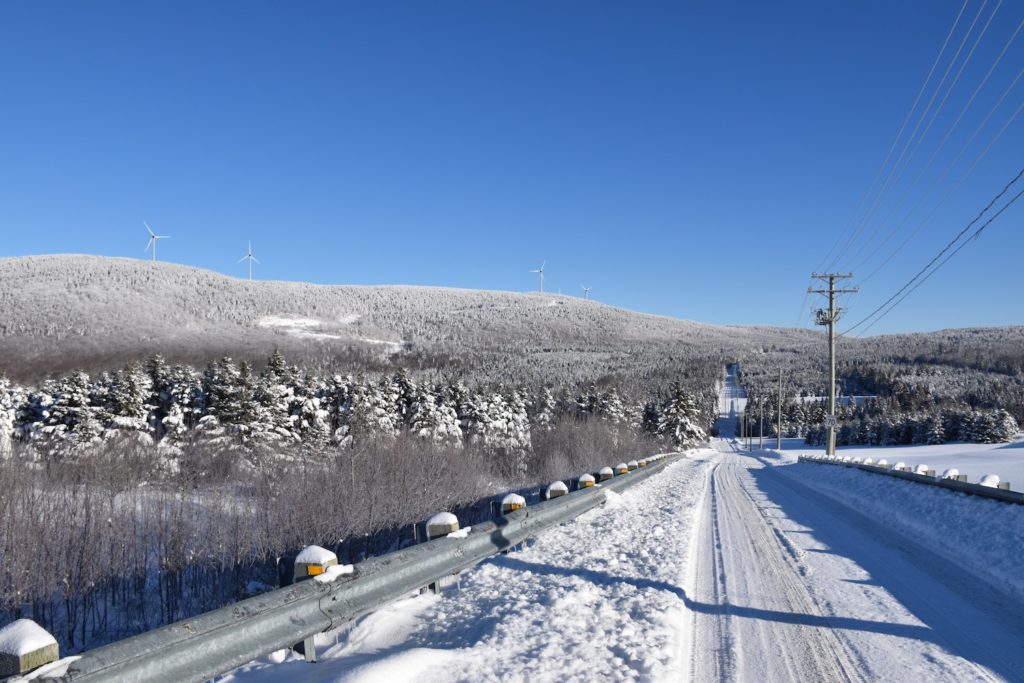
Photo: Wind turbines and electrical wires in Saint-Magloire in Quebec, by Claude Laprise / Unsplash